The RTP Decisions Umbrella
Scanning Comes First
Good decisions depend on good information.
That is why continuous scanning sits over the whole RTP driving routine.
Scanning is not a single look at the end of MSPSG or MSPS. It is the continuous process of gathering, assessing and using information to plan your driving safely.
A pupil who simply “looks” may glance in the correct direction but still miss important information. A pupil who is taught to scan continuously is more likely to recognise developing hazards early, plan ahead and make safer decisions.
Why Scanning Matters to the Instructor
Effective scanning also helps the instructor maintain control of the lesson.
The earlier you recognise that part of the pupil’s routine is becoming weak, rushed or incomplete, the more time you have to:
- question;
- prompt;
- provide information;
- adapt the task; or
- intervene if safety requires it.
This is the foundation of Spot It • Fix It • Prevent It. Good scanning helps you Spot It early, while there is still time to coach rather than simply react.
The RTP Decisions Umbrella
The RTP Decisions Umbrella brings continuous scanning and the driving routine together into one simple thinking process.
For the pupil, it provides a clear structure for gathering and using information throughout MSPSG in a manual car or MSPS in an automatic.
For the instructor, the same structure provides a powerful way to observe the pupil, recognise developing weaknesses and identify where their thinking or driving begins to break down.
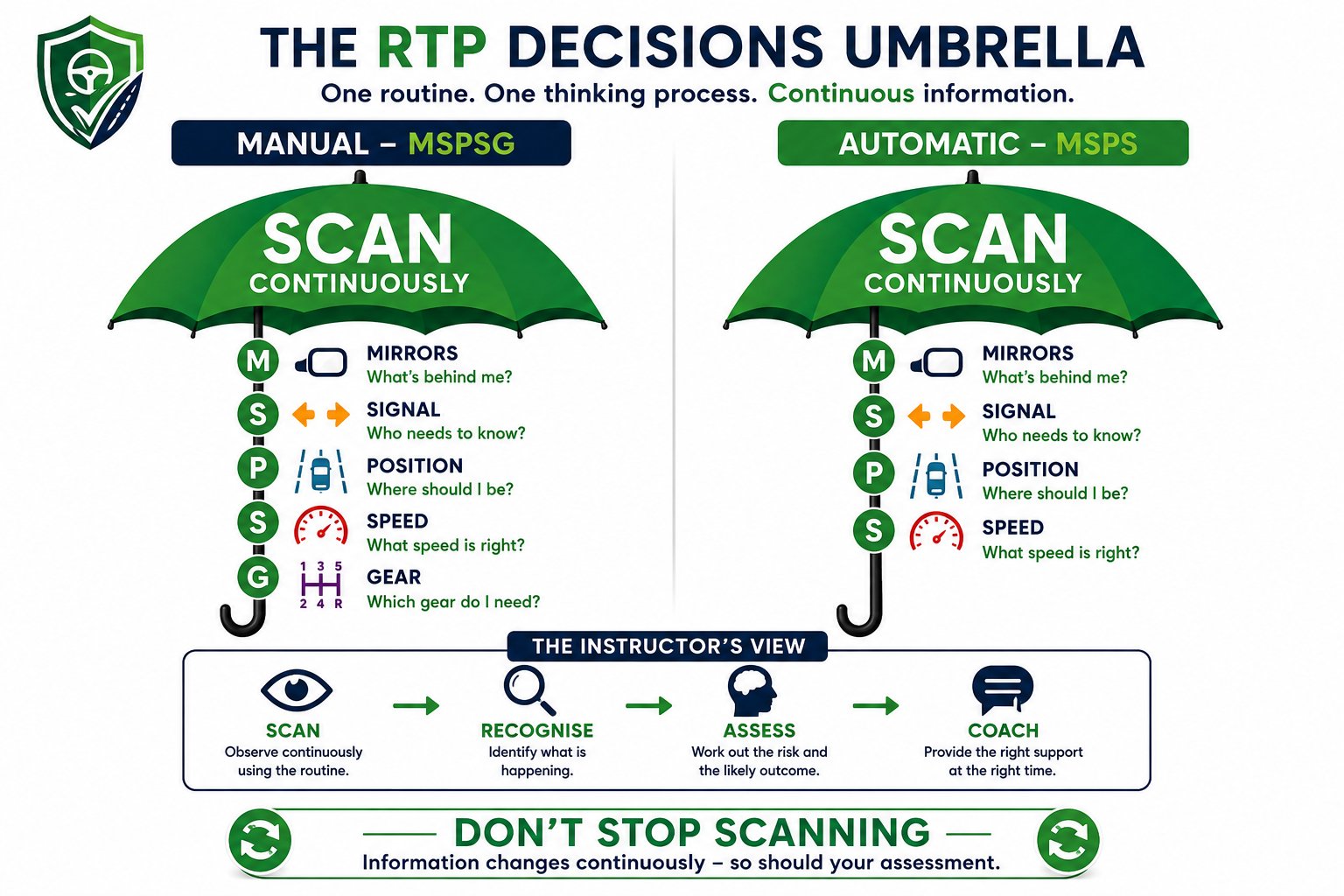
The pupil uses the Umbrella to structure their driving. The instructor uses the same Umbrella to assess what is happening and decide what support may be needed.
The aim is not simply to complete the routine in the correct order.
The aim is to continually gather, assess and use changing information to make safe, well-planned decisions.
As the routine becomes more consistent, weaknesses become easier to recognise — giving you more time to Spot It early, coach effectively and prevent the problem from developing further.
Teach Scanning — Don’t Just Mention It
Scanning is a skill and should be actively taught, practised and developed.
Learn where to look, how to move the eyes and how to avoid fixed staring.
Link scanning to hazards, planning, speed and decision-making.
Develop continuous, flexible scanning that remains effective in busy and complex situations.
The Goal
When scanning and the MSPSG/MSPS routine become habitual, pupils have more mental capacity available for planning and decision-making.
For the instructor, this structured routine also makes developing weaknesses easier to recognise. The better the routine, the easier it becomes to Spot It early.
```The RTP Teaching Framework
A Structured Lesson Creates Structured Learning
Delivering a successful driving lesson is about much more than choosing the right route or practising a particular subject.
Outstanding instructors work to a consistent teaching process that enables them to plan, coach, adapt and review every lesson whilst maintaining effective control of the learning.
The READY TO PASS Teaching Framework provides that structure.
Rather than following a rigid script, the framework gives you a logical process that can be adapted to suit every pupil, every lesson and every stage of learning.
As you become familiar with the framework, it becomes second nature, allowing you to concentrate less on what comes next and more on helping your pupil learn.
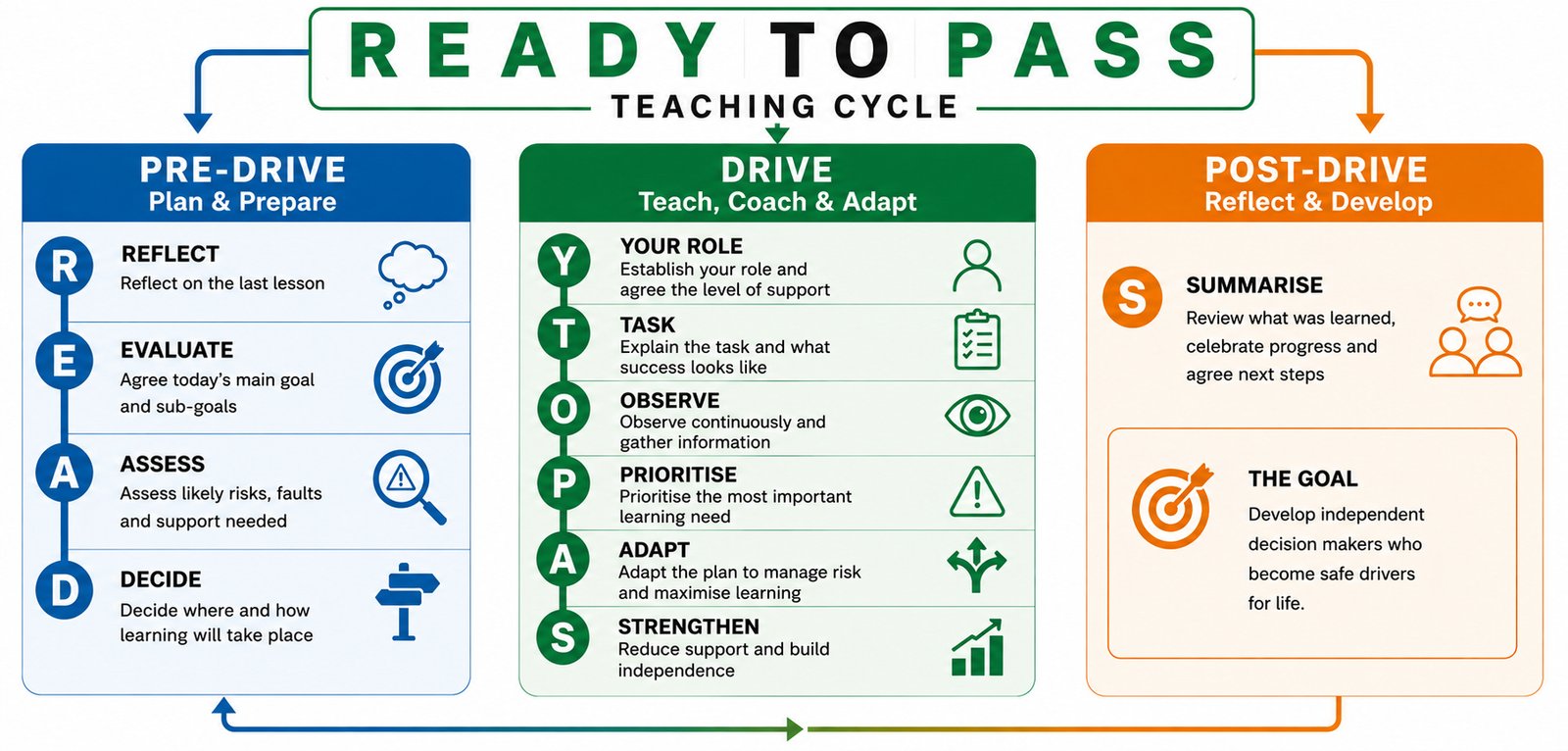
The Three Stages of Every Lesson
Agree what needs to be achieved before the vehicle moves.
Identify the pupil’s strengths, learning needs, level of support and any risks that may influence the lesson.
Observe continuously, coach the pupil and adapt the lesson whenever necessary.
As the pupil develops, continually adjust the level of support, manage risk and strengthen independence whilst maintaining effective control of the learning.
Review what has been achieved, celebrate success and identify the next steps.
Reflection helps the pupil understand not only what happened, but why it happened and how they can continue improving between lessons.
Why Use the RTP Teaching Framework?
The framework helps you to:
- deliver structured, consistent lessons;
- maintain effective control of the learning;
- adapt naturally to changing situations;
- provide clear evidence against the DVSA’s 17 competencies;
- encourage independent thinking and decision-making; and
- develop pupils into Safe Drivers for Life.
Building Strong Foundations
When used alongside the RTP Decisions Umbrella, the Teaching Framework provides a complete structure for every lesson.
Together, they form the foundations of every lesson delivered using the Ready To Pass Teaching System.
```The Five Steps to Teaching Safe Drivers for Life
Every Lesson Should Develop the Driver
Every driving lesson should move the pupil forward — not simply through another subject, but towards becoming a safer, more knowledgeable and more independent driver.
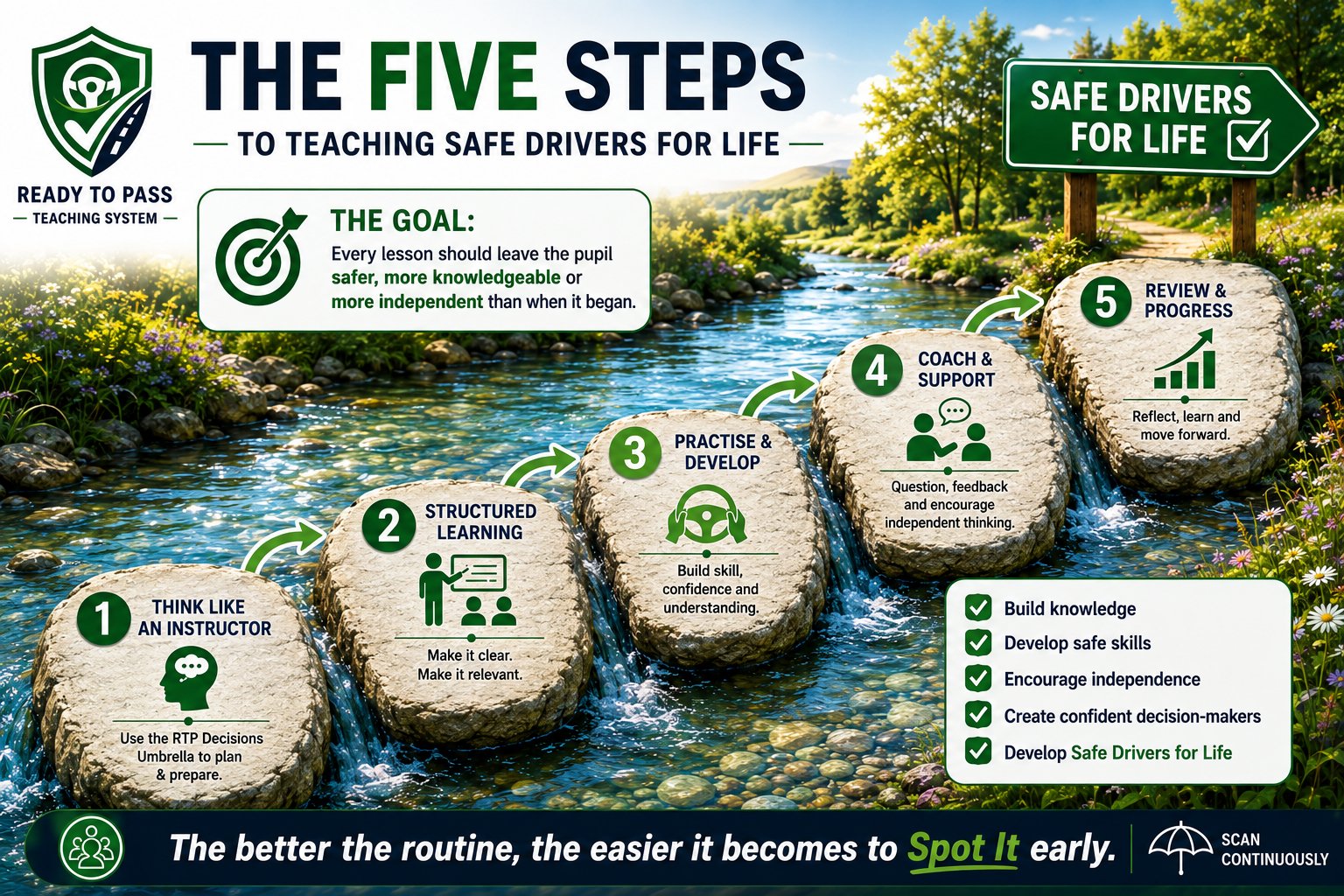
The RTP Five Steps provide a simple progression that helps instructors develop the pupil from understanding a task through to being able to make safe decisions for themselves.
The approach can be used with a complete beginner, an experienced learner or someone preparing for their driving test. The level of support will change, but the principle remains the same.
The Five Steps
Use the RTP Decisions Umbrella to observe, assess and identify what the pupil needs.
Make the learning clear, relevant and appropriate to the pupil.
Give the pupil the opportunity to build skill, understanding and confidence.
Use questions, feedback and the appropriate level of support to encourage the pupil to think and make decisions for themselves.
Reflect on what has been learned, recognise progress and agree what needs to happen next.
The Important Part — Keep Moving Forward
The Five Steps are not a rigid lesson script. Different pupils will progress at different speeds and may move backwards and forwards between the steps as their needs change.
Your role is to recognise where the pupil is now, provide the support they need and gradually reduce that support as their knowledge, skill and independence develop.
That is client-centred learning in practice.
From Structure to Practice
Understanding the Five Steps is one thing. Using them consistently is what develops you as an instructor.
The RTP In-Car Lesson Planner has been designed to help you put the RTP Teaching System into practice on every lesson.
Use it to help you plan the learning, agree the level of support, manage risk, recognise and prioritise learning needs, adapt when necessary and review what has been achieved.
Using the planner consistently helps you develop the structured approach required for your Part 3 or Standards Check, whilst building the habits you will need throughout your career as an instructor.
The aim is to use it until the structure behind it becomes your natural way of teaching.
Listen to Dave explain how to use the planner in the car and how each section helps you create the evidence an examiner needs to see.
Listen to the Planner Walkthrough →Bringing the Foundations Together
Helps you identify what is happening.
Gives you the structure to manage the lesson.
Help you develop the pupil towards independence.
Together, these foundations allow you to deliver structured, client-centred lessons whilst maintaining control of the learning and working towards the ultimate goal: Safe Drivers for Life.
```Spot It • Fix It • Prevent It
Don’t Just Correct Faults — Develop the Driver
Every pupil will make mistakes. Good instruction is not about preventing every mistake from happening — it is about recognising why it happened, dealing with any immediate risk and helping the pupil prevent it happening again.
The RTP approach is deliberately simple:
The earlier you Spot It, the more opportunity you have to coach the pupil before the situation develops into something requiring instructor intervention.
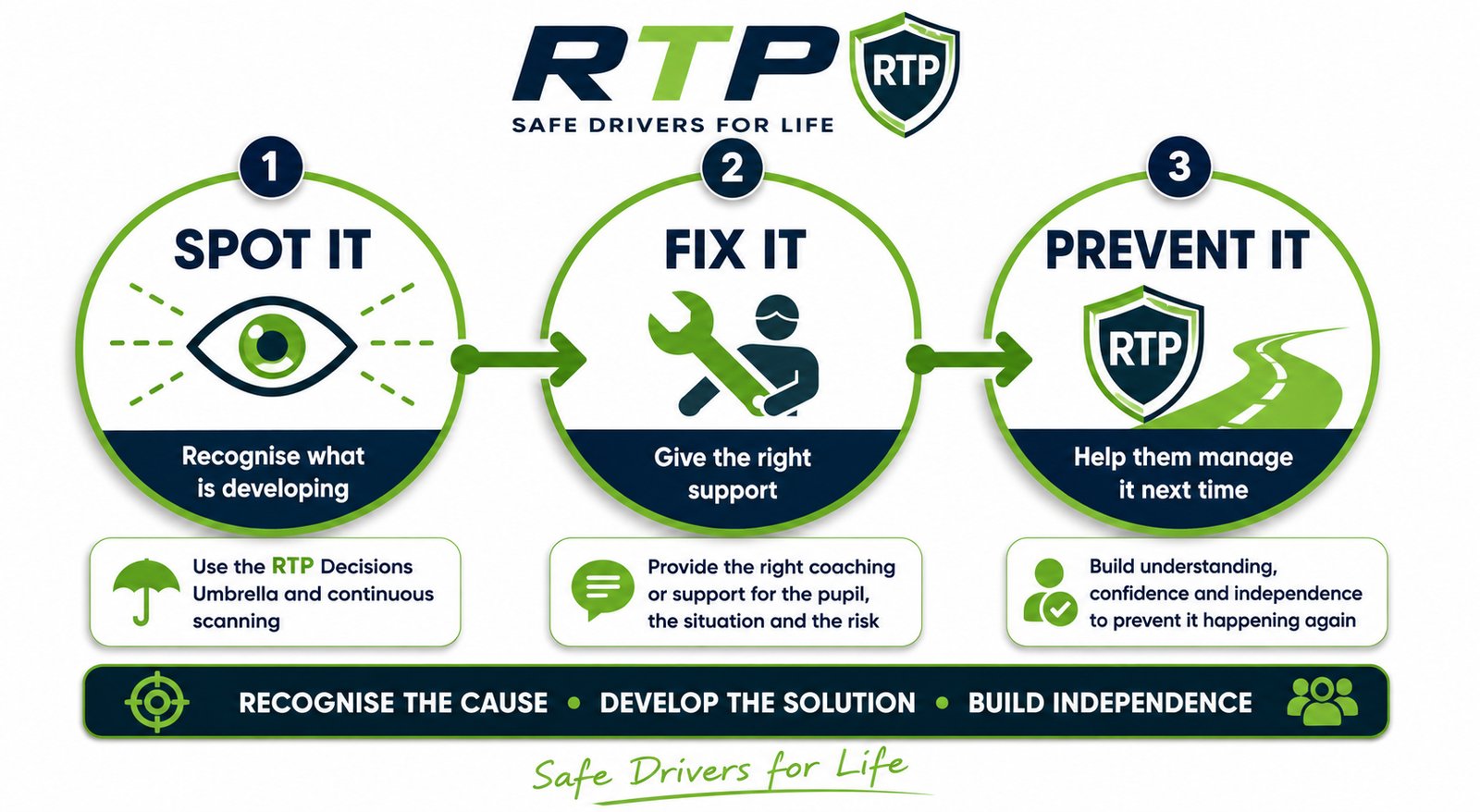
1 — Spot It
Recognise what is really going wrong.
Don’t wait for the final mistake.
Use the RTP Decisions Umbrella and continuous scanning to identify where the pupil’s decision-making process started to break down.
- What did I see developing?
- What information did the pupil miss?
- Which part of MSPSG/MSPS became weak or incomplete?
- Did the pupil recognise the risk?
- How early did I recognise it?
The aim is to identify the cause, not simply the eventual fault.
2 — Fix It
Deal with the problem at the right level.
Once you’ve identified what went wrong, decide what the pupil actually needs.
That might mean:
- asking a question;
- giving a prompt;
- providing information;
- demonstrating;
- changing the route or task;
- stopping somewhere safe to discuss it; or
- intervening where safety requires it.
The response should be appropriate to the pupil, the situation and the level of risk.
3 — Prevent It
This is where the real learning happens.
Correcting the immediate mistake is only part of the job.
The important question is:
Help the pupil understand:
Then give the pupil another opportunity to practise it.
The goal is not simply to produce a better result on the next attempt. The goal is to develop the pupil’s ability to recognise, assess and manage the situation independently.
Don’t Chase Faults
A developing instructor can easily spend the whole lesson reacting to individual faults:
That can become exhausting for the instructor and teaches the pupil very little.
Instead, look for patterns.
Fix the underlying weakness and several faults may disappear together.
That is why the RTP Decisions Umbrella sits at the heart of Spot It • Fix It • Prevent It.
Adapt the Lesson
If something important appears during the lesson, don’t continue with the original plan simply because that was today’s agreed subject.
Adapt.
If the pupil demonstrates a developing weakness or risk that needs attention, deal with it.
That might mean changing:
- the route;
- the exercise;
- the level of support;
- the lesson goal; or
- your teaching method.
After you’ve Spotted It, Fixed It and worked to Prevent It, don’t assume the learning has happened.
Reduce your support, revisit the situation where appropriate and give the pupil the opportunity to demonstrate what they can now do for themselves.
- Can they recognise the situation earlier?
- Can they identify the risk?
- Can they make the safe decision independently?
- Can they explain why their decision was safer?
That is how you prove the learning.
During a Part 3 or Standards Check, it isn’t enough for an examiner to hear you explain something or watch you correct a fault. They need to see evidence that learning is taking place.
Giving the pupil an opportunity to demonstrate improvement helps provide that evidence — and, more importantly, tells you whether your teaching has actually worked.
Prove It is not a test trick. It is simply good teaching.
Bringing It Together
Safe Drivers for Life
Ultimately, Spot It • Fix It • Prevent It isn’t really about driving faults.
It is about helping pupils learn from their own driving.
When pupils begin to recognise problems, understand risk and make better decisions without instructor input, they are becoming less dependent on you.
And that is exactly what we are trying to achieve: independent, thinking, Safe Drivers for Life.
```Building Safe Drivers for Life
The Test Is Not the Destination
Passing the driving test matters. But it is not the ultimate goal of driver training.
The real goal is to develop a driver who can recognise risk, make safe decisions and manage unfamiliar situations without an instructor sitting beside them.
That is what Ready To Pass means by:
Everything within the RTP Teaching System is designed to move the pupil gradually towards that level of independence.
Independence Has to Be Developed
A pupil does not become independent simply because the instructor stops helping.
Support should be reduced because the pupil is demonstrating that they need less of it.
As learning develops, your role should gradually change:
The aim is to move from the instructor making the decisions to the pupil increasingly making safe decisions for themselves.
What Does an Independent Driver Look Like?
An independent pupil increasingly:
- scans continuously;
- recognises developing hazards early;
- plans before situations become urgent;
- manages speed and position appropriately;
- identifies risk without being prompted;
- explains their own decisions;
- recognises and corrects weaknesses;
- reflects on what could have been better; and
- makes safe decisions without instructor input.
Control Without Creating Dependence
Within the RTP Teaching System:
The instructor must always maintain responsibility for safety.
But maintaining control of the lesson does not mean making every decision for the pupil.
Good instruction creates a safe environment in which responsibility can gradually be transferred.
The better you manage:
- risk;
- lesson structure;
- the level of support;
- task difficulty; and
- opportunities for reflection;
the more safely the pupil can develop independence.
Let the Pupil Think
One of the easiest traps for instructors is answering questions that the pupil could answer themselves.
A well-timed question, or simply giving the pupil a few extra seconds to think, may create far more learning than another explanation.
As the pupil develops, increasingly encourage them to:
That is how a learner gradually becomes a thinking driver.
The 17 Competencies — Naturally Demonstrated
When these foundations are used consistently, the evidence an examiner needs to see begins to appear naturally within the lesson.
The instructor is:
- agreeing meaningful learning goals;
- identifying and managing risk;
- matching support to the pupil;
- observing continuously;
- recognising developing faults;
- prioritising learning needs;
- adapting when necessary;
- using appropriate coaching techniques;
- encouraging reflection;
- reducing support; and
- developing independence.
These behaviours sit across the DVSA’s 17 competencies.
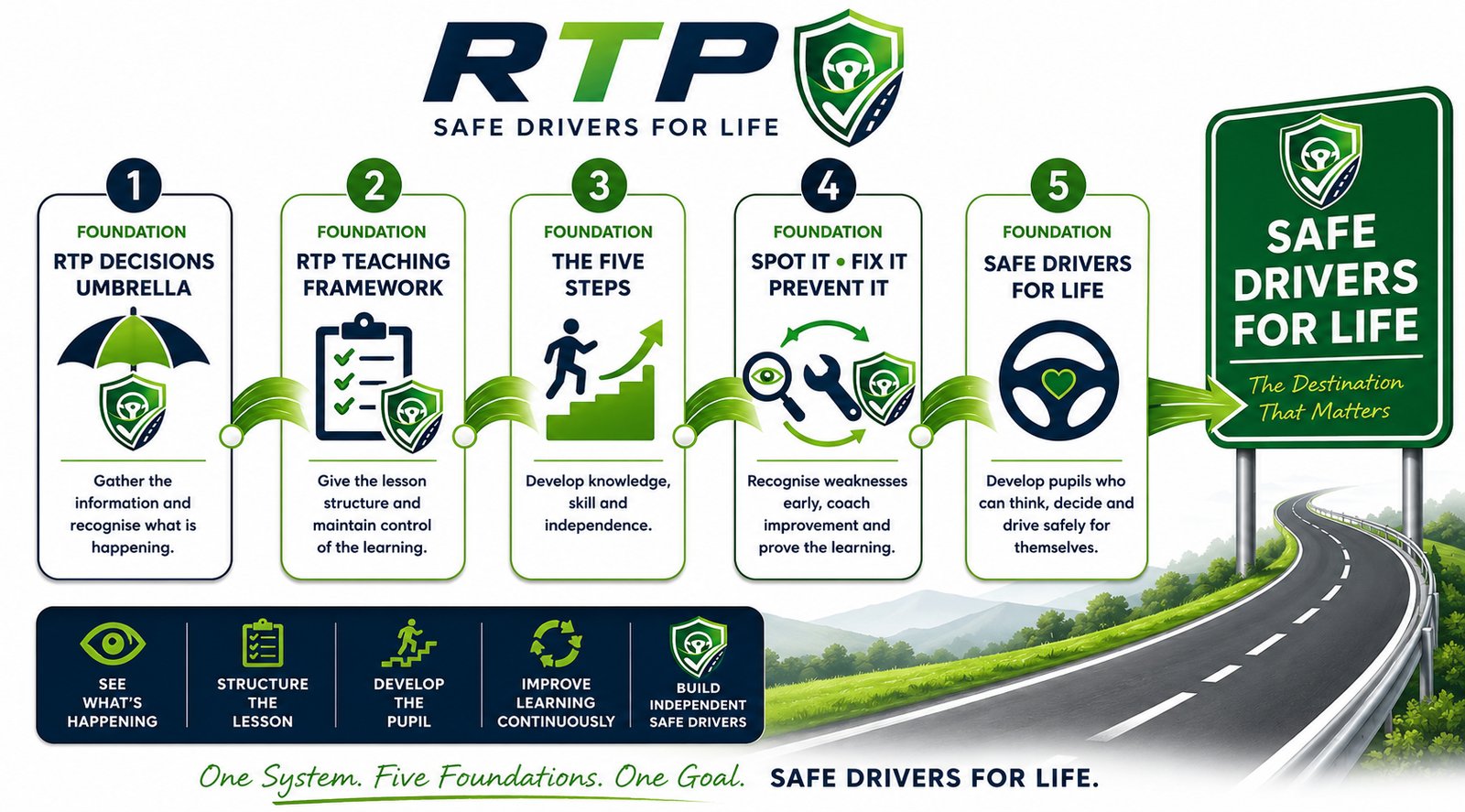
The Five Foundations Working Together
Your Role as an Instructor
Your greatest success is not when the pupil drives perfectly while you are helping them.
It is when they drive safely without needing your help.
Bringing It All Together
The RTP Teaching System is not designed to create one particular style of lesson.
It is designed to give you the structure, awareness and coaching tools needed to adapt your teaching to the individual pupil.
Use the Decisions Umbrella to gather information. Use the Teaching Framework to structure the lesson. Use the Five Steps to develop the pupil. Spot It, Fix It and Prevent It when learning begins to break down — and always Prove It.
Do these things consistently and you will naturally provide the evidence required against the DVSA’s 17 competencies whilst achieving something far more important: