Understanding the 17 Competencies
The Part 3 and Standards Check assess your ability to deliver a safe, effective and client-centred driving lesson across 17 competencies.
Those competencies sit within three main areas: Lesson Planning, Risk Management and Teaching & Learning Strategies.
The aim is not to treat them as 17 separate boxes or try to manufacture evidence for each one. A well-planned lesson, with effective risk management, appropriate coaching and a willingness to adapt to what is actually happening, will naturally provide evidence across several competencies at the same time.
Explore the Three Competency Areas
Working on a particular area? Select it below to go straight to the practical training, examples and exercises.


Identify needs, agree meaningful goals and create a lesson that can adapt as learning develops.

Observe continuously, recognise developing risk and provide the right level of support at the right time.

Adapt your teaching, create learning opportunities, give effective feedback and encourage reflection.
During a real lesson these things do not happen separately. They continually interact as you respond to the pupil, their learning and what is happening around you.
Plan the Learning — Not Just the Lesson
A lesson plan is not simply a route or a subject. It is a plan for helping this pupil make progress today.
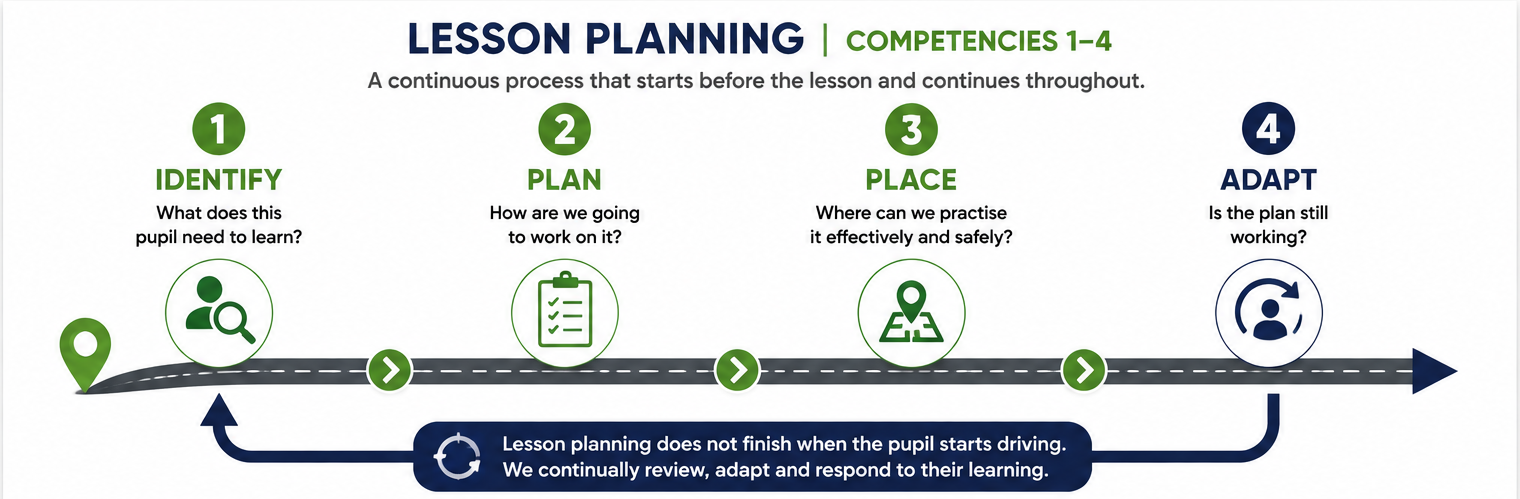
Effective lesson planning starts by understanding what the pupil actually needs, agreeing what success will look like, choosing an environment that supports that learning, and then continually checking whether the plan is still working.
The four Lesson Planning competencies therefore work together as one continuous process:
1 — Identify: What Does This Pupil Actually Need?
Pupils will often arrive with a subject they want to practise. Your job is to help them identify the actual learning need behind it.
Someone saying “I need to practise roundabouts” tells you the subject — it does not yet tell you what needs improving.
Questions That Help You Find the Real Need
Imagine a pupil says one of the following:
- “I want to do manoeuvres.”
- “I'm rubbish at meeting traffic.”
- “I need to practise junctions.”
- “My dad says my mirrors aren't very good.”
Before agreeing the lesson goal, ask yourself: What would I need to know before deciding what this pupil actually needs to improve?
Agree What Success Looks Like
A useful learning goal should allow both instructor and pupil to recognise when progress has been made.
There is no clear way to judge whether the goal has been achieved.
Both pupil and instructor can see whether learning has taken place.
2 — Plan: How Are We Going to Achieve It?
Once the learning need is clear, decide how the pupil is going to work towards it.
A good structure should provide enough challenge to create learning without overwhelming the pupil. Agree the starting difficulty, the level of instructor support and how success will be measured.
The RTP In-Car Lesson Planner
The RTP In-Car Lesson Planner is designed to help you build this thought process into every lesson.
It is not there because an examiner wants to see paperwork. Its purpose is to help you repeatedly practise a structured approach until that structure becomes your natural way of teaching.
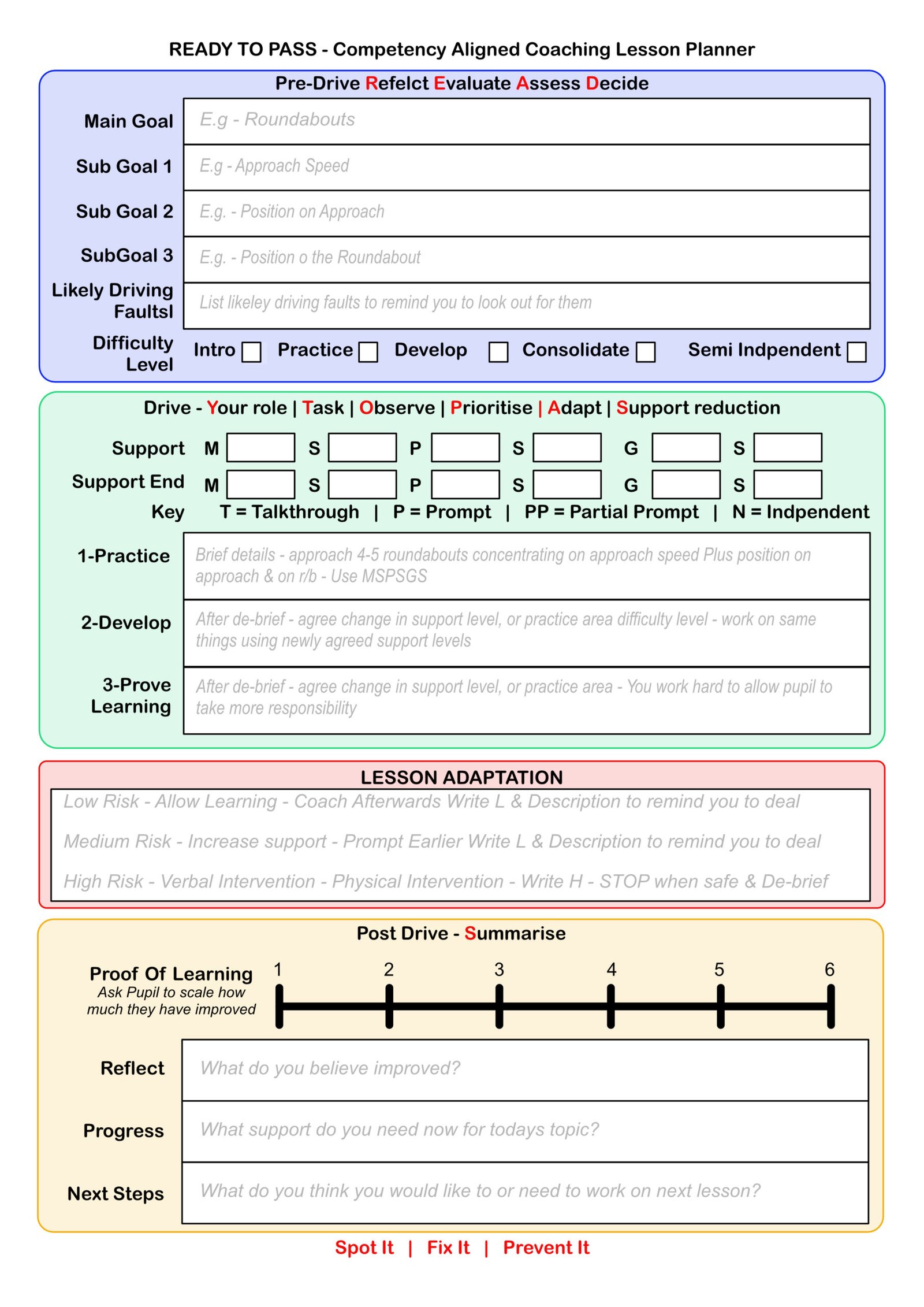
Use it until structured lesson planning becomes the way you naturally think.
3 — Place: Where Will the Learning Work Best?
The practice area is a teaching tool. The route should support the learning goal — not dictate the lesson.
A useful practice area should match the pupil's current ability and confidence, offer repeated opportunities to work on the agreed skill and allow the challenge to be increased or reduced when necessary.
Practice Area Challenge
Your pupil is developing their ability to deal with meeting traffic and clearance. They still require some prompting.
A narrow residential road with continuous parked vehicles, frequent opposing traffic and few opportunities to pause and reflect.
A quieter road with well-spaced parked vehicles, individual meeting situations and repeated opportunities to practise the same decision.
As the pupil improves, Area A may later become exactly the right environment.
The RTP Route Test
4 — Adapt: Is the Plan Still Working?
This is where lesson planning becomes live instructor judgement.
No lesson goes exactly to plan. Pupils progress at different rates, confidence changes, new learning needs appear and road conditions can alter without warning.
The examiner is not looking for an instructor who rigidly follows the original plan. They are looking for someone who recognises when the plan is no longer providing the best learning opportunity and adapts appropriately.
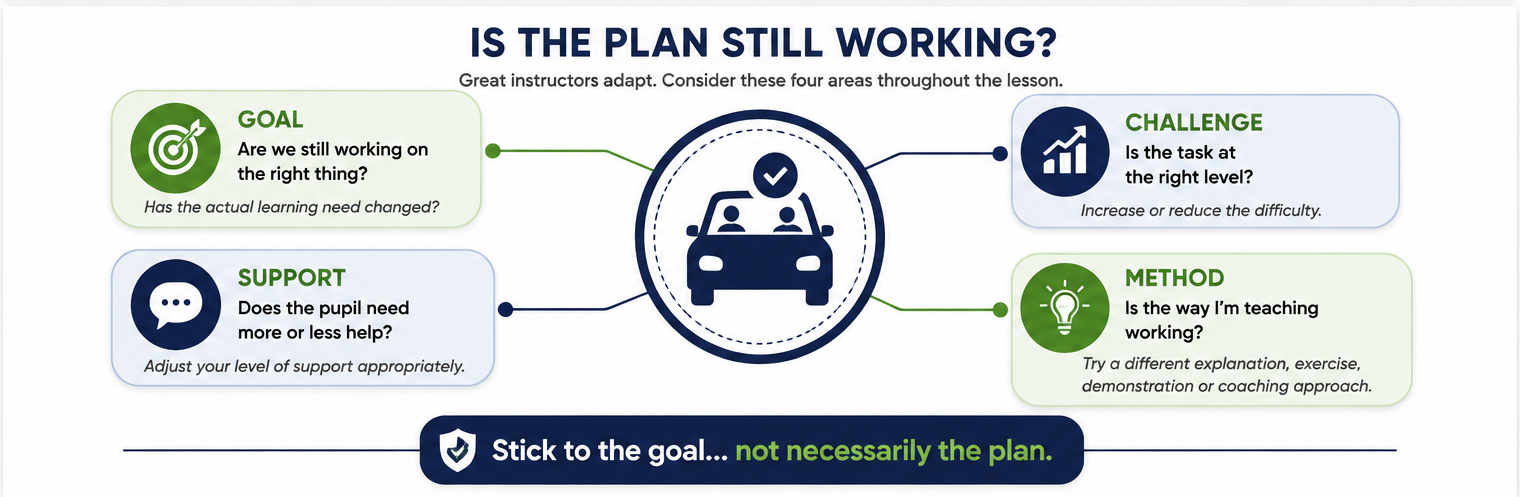
Four Things You Can Adapt
A different underlying learning need may have become more important.
Increase or reduce difficulty to maintain learning without overload.
Adjust instructor input as competence, confidence and risk change.
Change the explanation, coaching question, exercise or demonstration.
Would You Adapt?
Your pupil's goal is to deal with roundabouts more independently. They successfully negotiate the first three with very little support.
Do you continue repeating exactly the same exercise?
The agreed lesson is emerging at junctions. During practice the pupil repeatedly approaches too quickly and consequently has very little time to observe effectively.
Is observation really the main problem?
The pupil was coping well until traffic volume increased. They are now hesitating, missing information and requiring repeated prompts.
Do you abandon the goal?
Show Me the Evidence
Your pupil says: “I'd like to work on roundabouts because I never know when to go.”
Through discussion and observation you establish that they understand priority, but approach too quickly and consequently have insufficient time to scan and assess gaps.
Together you agree a measurable goal, select an appropriate practice area, begin with suitable support and increase the challenge as their performance improves.
You discovered the actual learning need and agreed the goal with the pupil.
You created an appropriate progression around that goal.
You selected an environment that provided suitable repetition and challenge.
You changed challenge and support as the pupil developed.
Common Lesson Planning Traps
Try This on Your Next Lesson
Plan with the pupil. Observe what actually happens. Adapt when necessary and keep the learning moving forward.